
From Simple Bots to Enterprise-Grade AI Agents
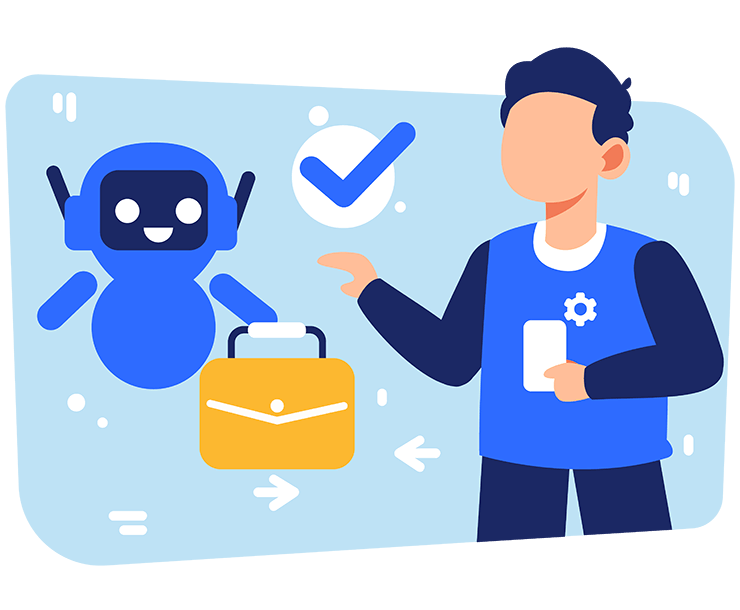
At Datasoft Global, Intelligent Automation & AI Agents means:
- AI systems that interpret requests from users or events
- Retrieve and reason over your internal knowledge (via RAG and embeddings)
- Decide and act within defined guardrails, calling APIs and updating systems
- Provide human-readable summaries and keep humans in the loop where needed
Common Areas Where We Deploy AI Agents


AI agents that triage tickets, propose responses, and resolve simple cases end-to-end.


Agents that monitor alerts, perform initial diagnostics, and execute routine remediation steps.


Agents that answer policy questions, assist with onboarding, and route HR requests.


Agents that classify transactions, validate data, and move information between systems.


Internal assistants that answer “how do I…” questions using internal SOPs, policies, and documentation.
Each agent is tailored to your vocabulary, tools, and processes — not a generic chatbot.
What Datasoft Builds Under Intelligent Automation & AI Agents
AI Copilots for Teams
We build embedded copilots inside the tools your teams already use:
- Side-panel assistants in web apps or portals
- In-product helpers that suggest next actions, responses, or content
- Context-aware assistants that understand the current screen, record, or ticket
Examples:
- A copilot for support agents that suggests replies and links knowledge articles
- A copilot for internal ops that explains data anomalies or suggests corrective steps
Task-Oriented AI Agents
Some workflows can be handled by agents with limited or no human intervention:
- Ticket routing and categorization based on content and historical patterns
- Document collection, validation, and status updates across systems
- Running checks (e.g., data quality, configuration) and logging results
We design these agents with clear boundaries, so you control what they are authorized to do and when they escalate to humans.
Workflow & Process Automation
We connect AI agents to your workflow engines and business rules:
- Automating repetitive steps across CRMs, ERPs, HRIS, and service desks
- Using AI to interpret unstructured inputs (emails, forms, documents) and map them into structured workflows
- Triggering approvals, notifications, and escalations based on AI classification and business rules
Our goal is to combine deterministic automation (RPA, workflow tools) with AI-driven understanding and decisioning.
Multi-Agent & Orchestrated Systems (Optional Advanced)
For more complex environments, we can design multi-agent systems where different specialized agents:
- Handle distinct tasks (e.g., information retrieval, analysis, action execution)
- Communicate via orchestrators or message queues
- Log their reasoning and actions for auditability
This is useful for scenarios like complex case resolution, compliance checks, or cross-system workflows.
How We Architect AI Agents in Your Environment
- Web widgets, chat interfaces, or in-app panels
- Integration with collaboration tools (e.g., Teams, Slack) if desired
- LLM or AI model orchestration layer
- Prompt templates and system instructions
- Business rules and policy checks embedded around the model
- RAG pipeline pulling from internal documents and systems
- Embeddings & vector stores for semantic retrieval
- Access control filters to enforce permissions
- API connectors to your systems (CRM, ERP, ticketing, HRIS, custom apps)
- Workflow engines or orchestration tools for multi-step automation
- Logging and audit trails for every action taken
Keeping AI Agents Safe, Controlled, and Auditable
Role-Based Access & Permissions
Agents can only see and do what they’re allowed to, based on your IAM model.
Guardrails & Policy Enforcement
Business rules and policy checks are applied before actions are executed.
Human-in-the-Loop Modes
- “Suggest-only” mode: agents propose actions; humans approve.
- “Auto for low-risk, manual for high-risk” based on confidence and impact.
Logging & Audit Trails
Every relevant decision and action is logged so you can review, debug, and satisfy compliance requirements.
Sample Intelligent Automation Projects
Support Ticket Triage Agent
- Need: High ticket volume, inconsistent categorization, and slow routing.
- Solution: An AI agent that reads incoming tickets, assigns category and priority, and routes to the correct team.
- Outcome: Faster response times, better queue balance, improved reporting.
Internal Policy & HR Assistant
- Need: Employees frequently ask repetitive questions about HR policies, benefits, and procedures.
- Solution: RAG-based assistant integrated into the intranet/portal. It answers policy questions and links to relevant pages, escalating complex issues to HR.
- Outcome: Fewer emails to HR, faster answers, better policy awareness.
IT Runbook Automation Agent
- Need: IT staff manually follow runbooks to handle common incidents and requests.
- Solution: Agent that reads alerts, checks runbooks, executes approved steps (restarts, checks, scripts), and documents actions.
- Outcome: Reduced MTTR and fewer after-hours interventions for common incidents.
Document Collection & Validation
- Need: Back-office teams chase missing documents and validate provided files manually.
- Solution: AI agent that emails or messages users, collects uploads, checks formats/content, and updates system statuses.
- Outcome: Fewer manual follow-ups and faster completion of onboarding / cases / applications.
How We Deliver Intelligent Automation & AI Agents
- Identify candidate processes for automation
- Evaluate data, systems, and risk level
- Define agent scope, guardrails, and integration points
- Build a constrained prototype (often in suggest-only mode)
- Test with a limited set of users or flows
- Harden the solution with monitoring, logging, and access controls
- Deploy to a pilot group, gather metrics and feedback
- Adjust prompts, workflows, and UI
- o Expand to more users, teams, or processes
- o Integrate with additional systems or data sources
- o Optionally introduce more autonomy where safe and justified
Part of a Connected AI Ecosystem
Intelligent Automation & AI Agents are most effective when built on a solid foundation:

They often start with the roadmap created in [AI Strategy & Consulting].

They reuse models, RAG pipelines, and integrations implemented in [AI Development & Integration].

They are supported long-term through Software & IT Services, including Managed Services, Cloud & DevOps, and Software Quality & Testing.
Why Datasoft Global?
We understand business processes, AI techniques, and the engineering needed to make them work in production.
From strategy and architecture to UI, integration, and operations — one partner across the lifecycle.
Agents are designed with permissions, guardrails, and auditability built in.
US-based leadership and dev center in India allow scalable, cost-effective delivery.
We focus on quick, contained wins first, then grow to broader automation once value is proven.