
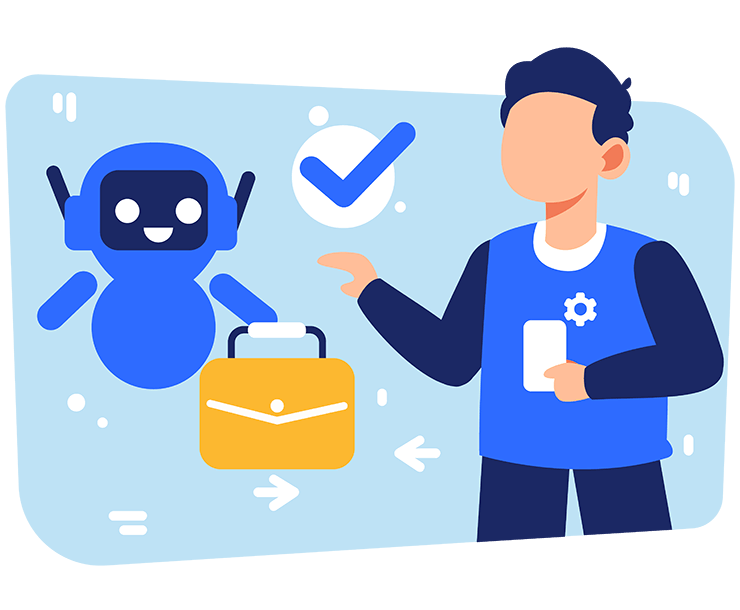
Turning AI From a Risk into a Managed Asset
- Policies: Clear rules for how AI can and cannot be used
- Processes: Who approves, reviews, and oversees AI initiatives
- Controls: Technical safeguards for data, access, and model behavior
- Monitoring: How AI performance, risk, and incidents are tracked over time
What Responsible AI Aims to Achieve


Protect sensitive data, systems, and users from misuse or exposure.


Reduce unintended bias in AI decisions and outputs where it matters.


Make sure stakeholders understand where and how AI is used, and what it’s allowed to do.


Align with your regulatory environment and define clear ownership of AI decisions and systems.


Ensure AI systems perform as expected and can be monitored, updated, or turned off when needed.
What Datasoft Delivers Under Responsible AI & Governance


We work with your leadership, legal, security, and technology teams to define a practical governance model:
- AI roles and responsibilities (e.g., owners, stewards, reviewers)
- Approval and review processes for AI projects
- Guidelines for when human oversight is required
- Alignment with your existing risk, security, and compliance structures
Outcome: A concise AI Governance Framework that fits how your organization already works—no unnecessary bureaucracy.
We help you create clear, usable policies so employees know what’s allowed:
- Acceptable use policy for GenAI and external AI tools
- Guidelines on what data can be sent to external models
- Standards for using internal AI systems and assistants
- Requirements for data retention, logging, and oversight
Outcome: A set of policy documents and standards that can be shared across the organization and used in training.
For higher-risk AI initiatives, we support structured assessment:
- Risk assessment templates for AI projects
- Impact analysis on customers, employees, and operations
- Mapping AI use cases to relevant regulations and internal policies
- Recommendation of mitigation steps (controls, approvals, monitoring)
Outcome: Risk & impact assessments your leadership can use to decide where and how to proceed.
We translate governance into technical controls:
- Role- and attribute-based access to models, data, and prompts
- Data classification and filtering before it reaches a model
- Prompt templates and system instructions that enforce guardrails
- Logging and audit trails for prompts, outputs, and actions
- Guardrail layers (e.g., content filters, safety checks) around model outputs
Outcome: A set of implementable technical controls that your engineering and security teams can own and extend.
We help you define how AI systems are approved, monitored, and updated:
- Entry criteria for moving from pilot to production
- Monitoring of model performance, drift, and incidents
- Processes for retraining or switching models
- Decommissioning or rollback procedures when needed
Outcome: A lifecycle governance blueprint so AI systems are not “set and forget”.
AI governance only works if people understand it:
- Training sessions for executives and managers on AI risks and responsibilities
- Practical guidance for developers, data scientists, and product owners
- Awareness materials for business users on how to use AI tools safely
Outcome: A basic training and awareness program that makes governance real, not just a document.
Our Responsible AI & Governance Engagement Approach
- Review existing security, risk, and compliance frameworks
- Identify current and planned AI use cases
- Understand internal policies, data classifications, and regulatory context
- Draft or refine AI governance framework and decision-making model
- Define policy set (acceptable use, data usage, internal AI standards, etc.)
- Align with legal, risk, security, and HR stakeholders
- Identify required technical controls and integration points
- Map governance elements to specific systems and teams
- Define monitoring and reporting approach
- Support in communicating and rolling out policies
- Conduct training sessions and workshops
- Provide guidance for the first set of projects under the new framework
Where Clients Use Responsible AI & Governance
GenAI Use Policy & Guardrails
A company wants to roll out generative AI tools internally but is concerned about data leakage and reputational risk.
Datasoft helps design an acceptable use policy, set up controls for data sharing, and configure logging and access boundaries for internal and external tools.
RAG Assistant for Sensitive Documents
An organization wants a knowledge assistant over internal policies, contracts, or healthcare documents.
Datasoft defines access rules, implements permissions-aware retrieval, and sets controls on what content can appear in answers, along with audit logging.
AI in Customer-Facing Workflows
A client is embedding AI into a customer portal.
Datasoft guides risk and impact assessments, sets review and escalation processes, and helps define disclaimers, logging, and human-in-the-loop checkpoints.
Governance Across Your AI & Software Lifecycle
Responsible AI & Governance is not an isolated service. It underpins your broader AI and IT strategy:

[AI Strategy & Consulting]
Identifies where AI governance is most critical in your roadmap.

[AI Development & Integration]
Implements technical guardrails, logging, and access controls as part of solution design.

[Intelligent Automation & AI Agents]
Implements technical guardrails, logging, and access controls as part of solution design.

AI Data, RAG & Vector Search
Applies governance to how content is ingested, indexed, retrieved, and exposed to users.

Software & IT Services / Managed Services
Provides operational support, monitoring, and continuous improvement under your governance model.
This means governance is built in, not bolted on later.


Why Partner with Datasoft on Responsible AI?
We understand AI models, software architectures, data pipelines, and the security/compliance implications that come with them.
We design frameworks and policies that your teams can actually follow, not just theoretical models.
Governance is woven into how we design and build AI systems—not treated as a separate afterthought.
With teams in the US and India, we understand diverse regulatory and operational environments.
We are prepared to support you as regulations evolve and your AI footprint grows.